How to Edit Course Format v2

You need LMS Admin or Trainer access to be able to perform this action.
What is Course Format?
A Course Format refers to the layout of a course. The course format can be selected in Administration > Course administration > Edit settings. This guide covers the available course formats:
Custom Sections Format
The Custom Sections format is the most common LMS Course Format. Customisable sections of content which are laid out similar to chapters of a book. Each topic section may contain activities, resources and labels. This is the default course format.
How to Custom Sections Format in LMS
Step 1: From the Home Page, Login using your Admin credentials.
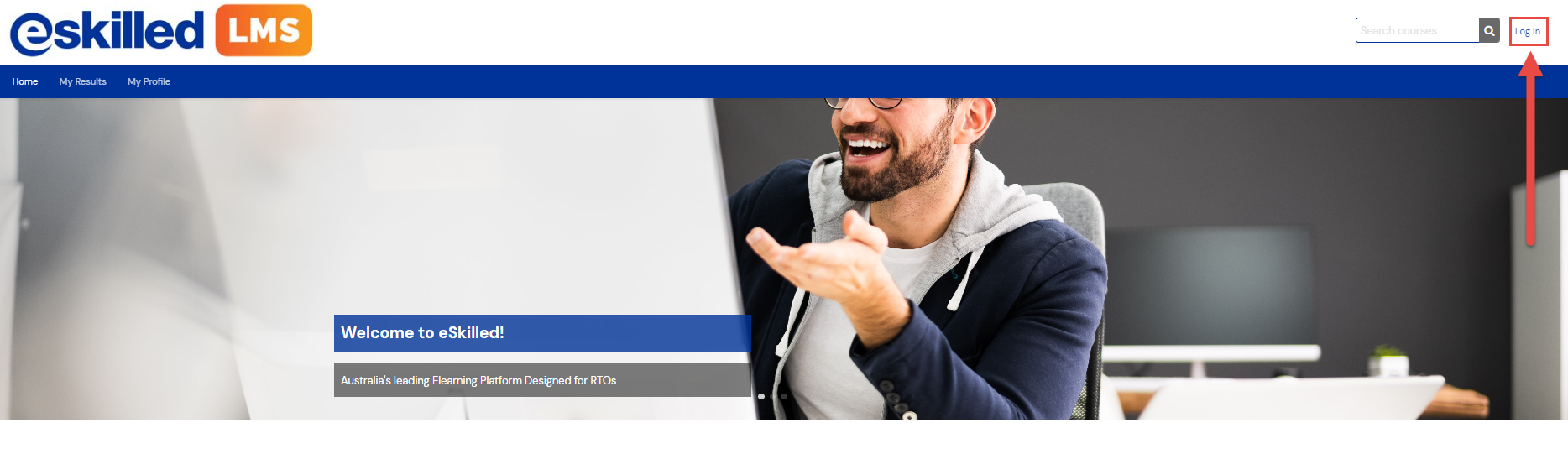
Step 2: Search for the course you want to edit the course format, then click the course title to access the course.
Step 3: Click the 'Settings' on the course page.
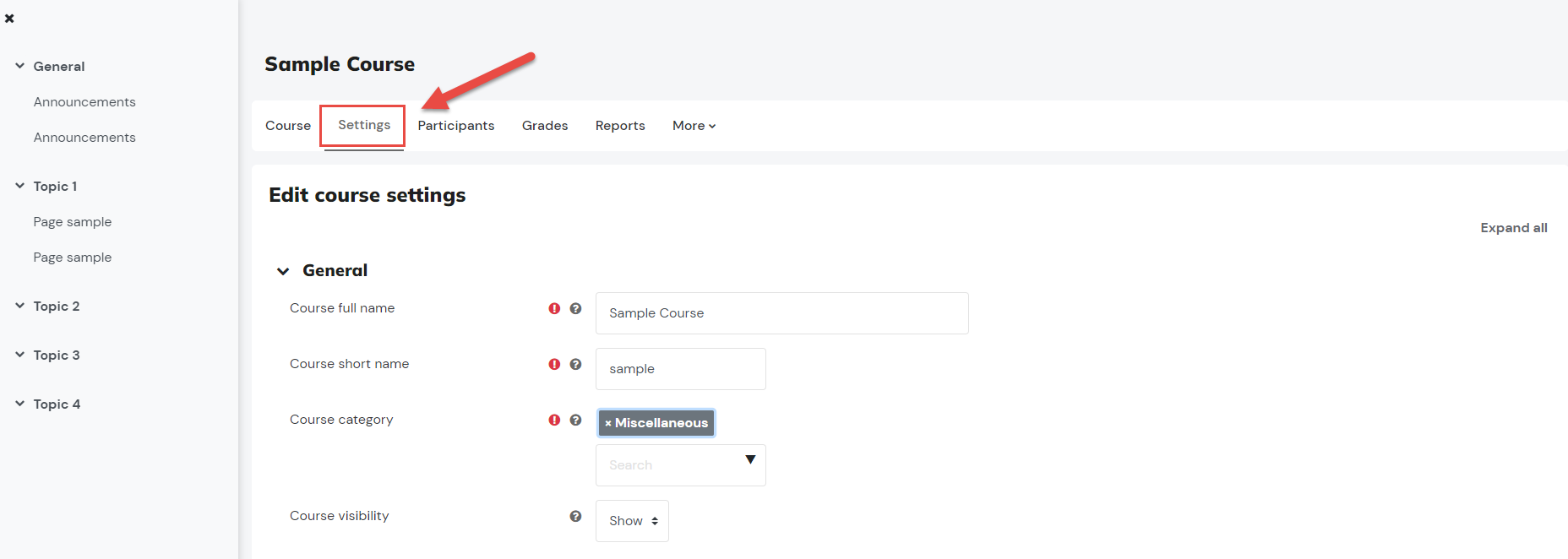
Step 4: Scroll down to Course Format. Select Custom Sections from the drop-down menu.
Step 5: Click Save and Display.
This is the Custom Sections Format of the Course with the Topic Index at the left side.
Tiles Format
A course format which displays course topics as "Tiles", in a grid rather than as a list. When clicked, tile content is displayed under the tile with an animated transition. The layout adapts to different screen sizes and orientations. Within each tile, activities can also be set to display as "sub-tiles". For each tile, the teacher can pick an icon from a predefined set, or upload a background photo.
How to Set-Up Tiles Format in LMS
Step 1: Click the 'Settings' on the course page you desire to change course format into tiles.
Step 2: Scroll down to Course Format. Select Tiles format from the drop-down menu.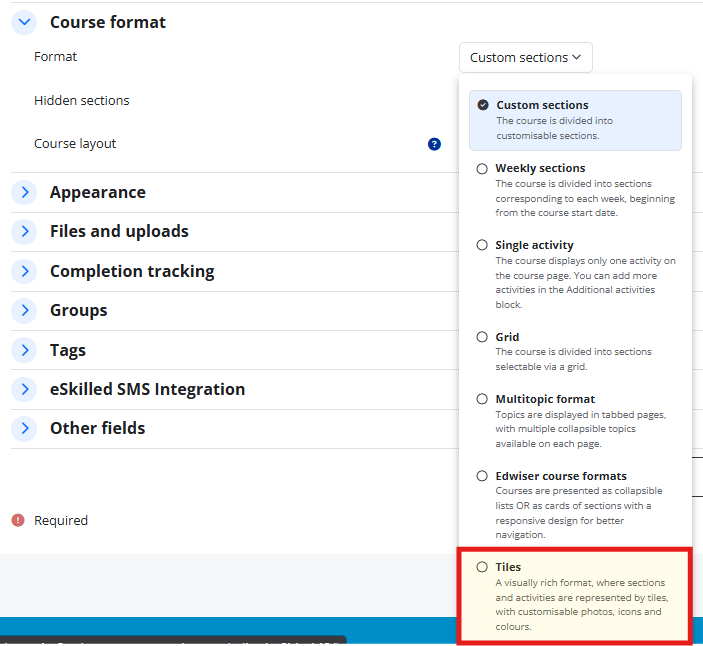
Step 3: Additional setup for Tiles format will show, you may now choose your desired icon and color or set the other setting like the Progress on each tile. Click Save and Display when done.
This is the Tiles Format of the Course.
Grid Format
A modular and visual course format. Hides all topics and creates a grid of icons (one for each topic) with short titles. Clicking on an icon brings up the content from the corresponding topic.
How to Set-Up Grid Format in LMS
Step 1: Click the 'Settings' on the course page you desire to change course format into grid.
Step 2: Scroll down to Course Format. Select Grid from the drop-down menu.
Step 3: Additional setup for Grid format will show, you may also set the number of sections here. Click Save and Display when done.
Step 4: On the Course page, you have the option to add an image that depicts the section. To do this, click the the change the image hyperlink. (Don't forget to toggle 'Edit mode'.
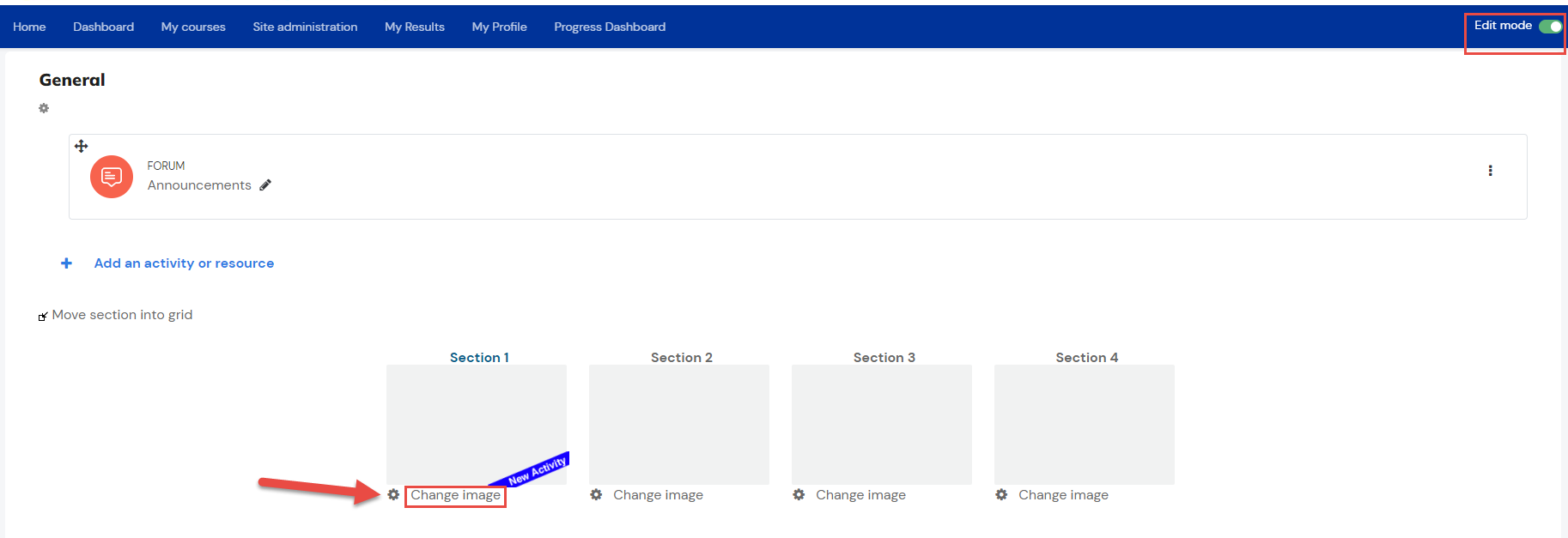
Step 5: Drag and drop your desired photo for the section.
This is the Grid Format of the Course.
Multitopic Format
This course format is designed to structure course content into topics or sections, with a more compact and visually organised layout than the standard Topics format.
This can be particularly useful for RTO/LMS implementations with many units, learning resources, assessments and supporting activities, because learners can focus on the section they are currently completing.
How to Set-Up Multitopic Format in LMS
Step 1: Click the 'Settings' on the course page you desire to change course format into grid.
Step 2: Scroll down to Course Format. Select Multitopic from the drop-down menu.
Step 3: Click Save and Display.
This is the Multitopic Format of the Course with the Topic Index at the top area.
Extra Feature: Dynamic Progress Tab Colours (Multitopic Format)

Note: You need to contact eSkilled Support at support@eskilled.com.au if you want this feature activated in your site.
Course tabs automatically update their colours based on learner activity progress and completion states.
Tab Colour States
Colour | Priority | What It Means |
Grey | 1 | The learner has not started any activities in this section yet. |
Amber | 2 | The learner has started some activities but has not yet completed all of them. There may be activities still awaiting a grading outcome. |
Blue | 3 | The learner has completed and submitted all activities in this section, but at least one is still awaiting a grading result. The learner has done everything they can for now. |
Green | 4 | All activities in this section are complete and have met their pass requirements. The section is fully done. |
Red | 5 | At least one activity has been graded, and the learner has not met the required pass mark. Action is needed. |
Learner Progress Detection
The feature evaluates:
- Completion tracking
- Submission status
- Grade status
- Pass/fail requirements
Parent Tab Aggregation
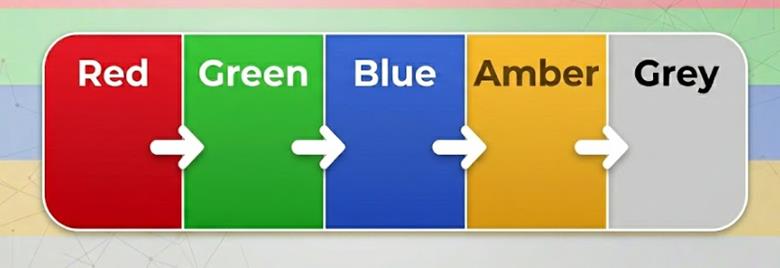
Parent tabs automatically inherit child section states using the following priority logic:
How Parent Tabs Work
Where a tab contains sub-sections, its colour is automatically determined by the combined
state of everything inside it. The rules, in priority order, are:
Colour | Priority Order |
Red | If any sub-section is red, the parent is red — failure always surfaces to the top. |
Green | If every sub-section is green, the parent is green. |
Blue | If there is no red or amber, and at least one sub-section is green or blue, the parent is blue — the learner has done all they can across the section. |
Amber | If any sub-section is amber (and none are red), the parent is amber. |
Grey | If all sub-sections are grey, the parent is grey. |