How to Add and Move a Block

Overview
Blocks are items which may be added to the side inside the block drawer of any page in Moodle. Different themes allow blocks to be added to the left, right or both sides. They may also be added to the centre of the Dashboard.

NOTE: You need LMS Admin access to perform the following actions.

Step Tutorial
1. Enable editing: Click on the gear icon and select Turn editing on.
2. Locate the ‘Add a block’ section: This is usually on the left or right side of the page.
3. Choose a block: Click Add a block, then select the desired block from the list. Below are the blocks you can add:
Accessibility
Provides tools and shortcuts to improve and support course accessibility.
Accessibility review
Scans course content and highlights accessibility issues that need fixing.
Activities
Gives a quick overview and links to all activities in the course.
Activity results
Displays results, grades, or outcomes from selected course activities.
Admin bookmarks
Lets admins save and quickly access frequently used admin pages.
Administration
Central hub for course or site settings and management options.
Advanced notifications
Sends custom alerts based on specific course or system events.
Attendance
Tracks, records, and manages student attendance in sessions.
Blog menu
Provides navigation to blog-related functions like viewing or posting entries.
Blog tags
Shows commonly used or recent tags from blog posts for quick browsing.
Calendar
Displays important dates, deadlines, and upcoming course or site events.
Comments
Allows users to view, add, and manage comments within the course.
Completion Progress
Visual tracker showing which activities have been completed.
Configurable Reports
Allows creation of custom reports using flexible filters and data.
Course completion status
Shows learner progress toward meeting course completion requirements.
Course contents
Displays structured sections, topics, and materials within the course.
Course Module Navigation
Enables quick jumping between different course activities/modules.
Course/site summary
Provides a brief overview or description of the course or site.
Courses
Lists available, enrolled, or accessible courses for the user.
Dedication
Estimates learner engagement time based on activity usage.
Feedback
Collects responses from users through surveys or feedback forms.
Filtered course list
Displays courses based on selected filters or categories.
Global search
Searches across all courses, activities, and site content.
Latest announcements
Shows the most recent announcements from course forums.
Latest badges
Displays recently earned badges by learners.
Learning plans
Shows structured competency-based learning paths and goals.
Logged in user
Displays information and quick links for the current user.
Mentees
Shows a list of users assigned to you as mentees.
Microsoft block
Provides integration with Microsoft tools like Teams or OneDrive.
Navigation
Main menu for moving through courses and site areas.
Online users
Shows users currently active or logged into the course.
OpenAI Chat Block
AI-powered chat assistant embedded within the course.
Private files
Personal file storage area for individual users.
Program Overview
Summarizes programs the user is enrolled in.
Quickmail
Enables sending emails directly to course participants.
Random glossary entry
Displays a randomly selected glossary term for learning.
ReadSpeaker webReader
Text-to-speech tool that reads course content aloud.
Recent activity
Shows the latest updates and actions within the course.
Recent blog entries
Displays newly published blog posts.
Search forums
Lets users search discussions within course forums.
Self completion
Allows learners to manually mark a course as completed.
Slider
Displays rotating banners or featured content.
Tags
Shows tagged items to help categorize and discover content.
Text
Simple block for adding static text or HTML content.
Time
Displays current time or time-based information.
Zendesk ticket
Allows users to create or view support tickets.
Upcoming events
Lists scheduled future events in the course or calendar.
NOTE: Not all of these blocks will be available on your end; this is simply a consolidated list of blocks available in Moodle.
4. Position the block: Once added, you can move it using the drag-and-drop method.
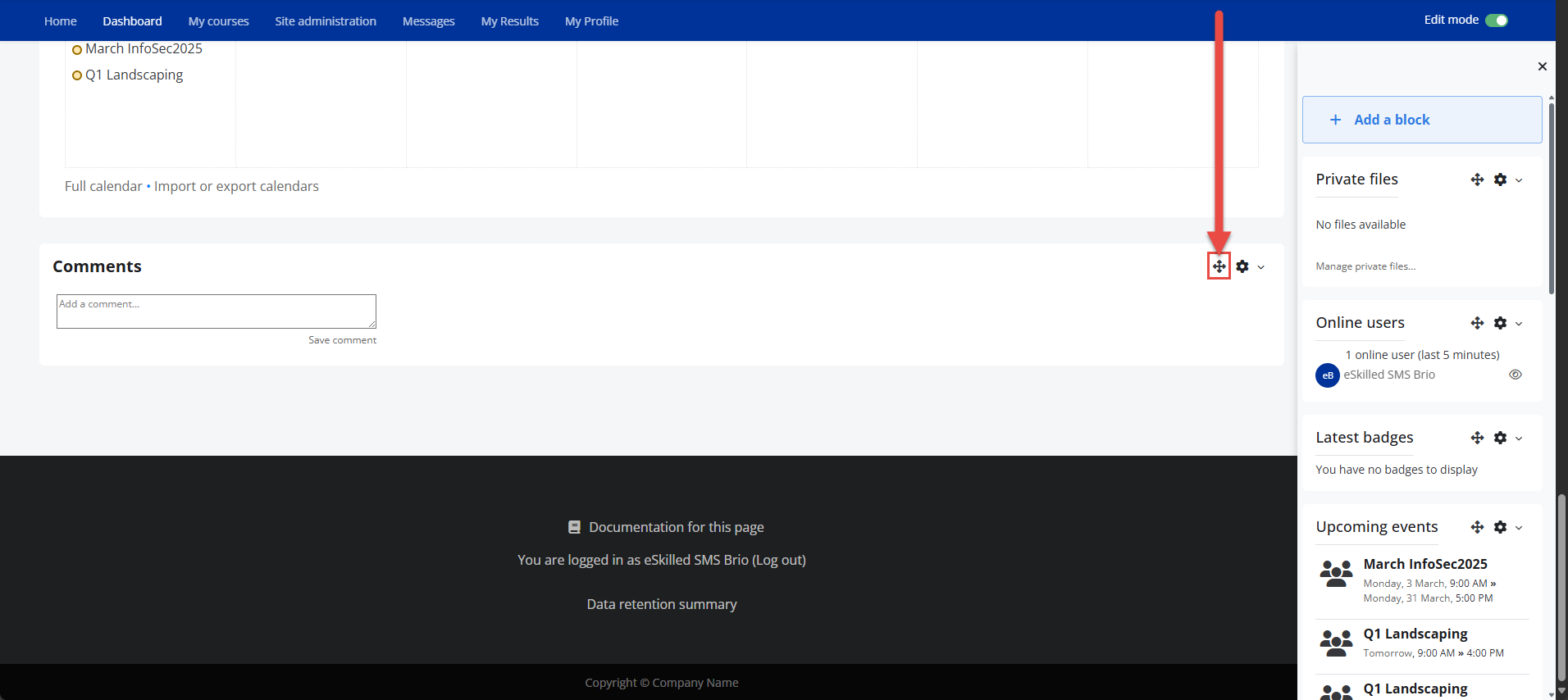
5. Save and exit: Once satisfied, turn editing off.
The steps above explain how to add and move a block.
Congratulations on completing this tutorial. We hope this has been helpful to you and your organisation. For any questions or concerns regarding this function, please reach out to the contact support via email.
FAQs
Who can access the Online Users block?
By default, this block is visible to all logged-in users (including students, trainers, and administrators), as long as it is added to a page they have access to. The users shown in the list depend on the viewer’s permissions, so individuals will only see other users they are allowed to view within that course or context.
For Students: They can see other students, teachers, and non-editing teachers who are currently online in the same course.
For Trainers (teachers/non-editing teachers): They can see all enrolled participants in the course who are currently online.
For Administrators: They can see all users online within the course.
This block is set up using LMS' default configuration. If you would like to make any changes—such as restricting visibility to specific roles or modifying how the block behaves—please contact our Support Team with your requirements, and we will assist accordingly.